 f
f

%20at%20National%20Football%20Museum%2C%20Manchester%2002.jpg)
Almost a century of World Cups adds up to a lot more than results and top scorers. It adds up to unsolved thefts, a protest disguised as confusion, a country that changed hosts without a ball being kicked, and a player who lost a final with one country and won the next one with another. Here are 20 of the most curious stories the tournament has left behind, in chronological order.
The first World Cup was played by invitation only (1930)
Uruguay 1930 had just 13 teams, and none of them got there by qualifying — every single one was invited directly by the organizers. Crossing the Atlantic by boat took nearly three weeks, and that meant only four European teams agreed to go: France, Belgium, Romania and Yugoslavia — everyone else stayed home.

Photo: Jules Rimet hands the trophy to Raúl Jude after the 1930 final · El Gráfico, 1930 · public domain
The first goal in history was scored by a Frenchman (1930)
Lucien Laurent scored for France against Mexico, earning himself a place in history without even knowing it at the time — France was eliminated in the group stage that same tournament.
He lost one final and won the next one with a different country (1930→1934)
Luis Monti played the 1930 final with Argentina and lost it. Four years later, now a naturalized Italian citizen, he played the 1934 final with Italy and won it. He's the only man in history to lose a World Cup final with one country and lift the trophy with another.
Sweden advanced a round without playing a single match (1938)
Days before the tournament kicked off, Germany annexed Austria, and the Austrian team — already qualified — disappeared overnight. Nobody took their place: Sweden, their first-round opponents, advanced straight to the quarterfinals without playing a single minute, then thrashed Cuba 8-0.
The final that was never actually a final (1950)
The Maracanazo remains, to this day, one of the biggest upsets in the history of sport — and technically, it wasn't even a final. Read the full story in our dedicated piece.
Cards were born from a traffic light (1966)
At that same World Cup, Argentine captain Antonio Rattín refused to leave the pitch after being sent off against England, claiming he didn't understand the German referee. An English referee, looking at a traffic light in London shortly after, came up with the idea of a universal color system to avoid the problem.
Cards debuted four years later (1970)
The traffic-light idea only became official at the 1970 World Cup in Mexico, the first tournament to use yellow and red cards.
A protest disguised as confusion (1974)
Zaire defender Mwepu Ilunga ran out of the wall to kick away a Brazil free kick before it was taken — for years it was assumed he simply didn't understand the rules. Decades later, he explained it was a deliberate protest: the team had gone weeks without being paid their bonuses, and he wanted to get sent off.
The only twins to each score at the same World Cup (1978)
René and Willy van de Kerkhof, identical twins from the Netherlands, each scored their own goal at Argentina 1978 — a milestone no other pair of twins has repeated since. Read the full story in our dedicated piece.
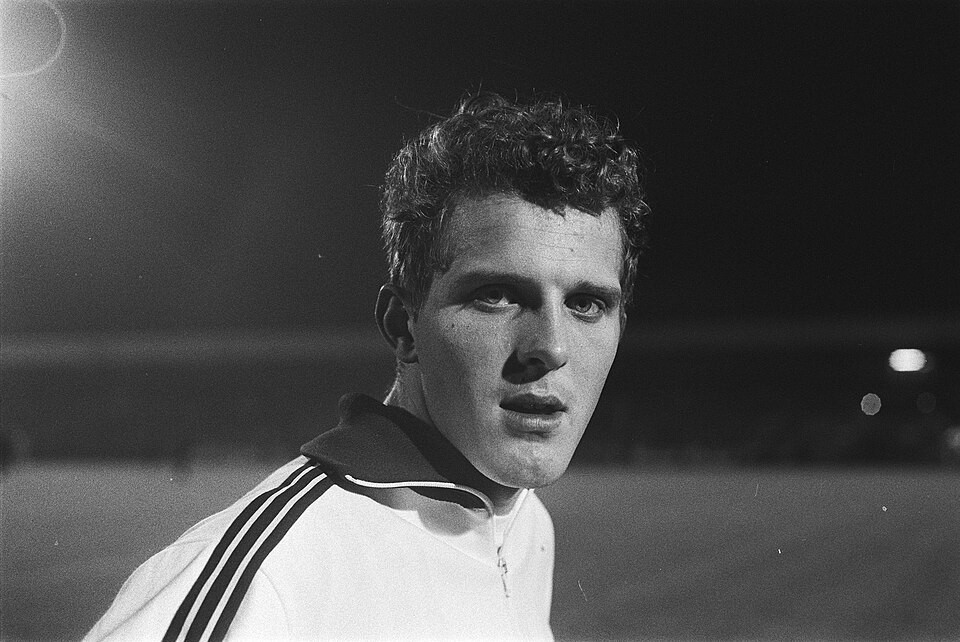
Photo: Nationaal Archief, licensed under CC BY-SA 3.0 NL
The Night of Seville (1982)
West Germany and France played the first penalty shootout in World Cup history, after a drama-filled 3-3 semifinal. Germany won 5-4 and advanced to the final.
The trophy went missing again, this time for good (1983)
The Jules Rimet trophy, already given permanently to Brazil after their third title, was stolen from the Brazilian federation's offices in Rio de Janeiro. It was never recovered — it's believed to have been melted down.
The only player to score for two different countries (1990 and 1998)
Robert Prosinečki scored for Yugoslavia in 1990, and eight years later, now as an independent country, scored for Croatia in 1998. No other player in history has scored World Cup goals for two different national teams.
The fastest goal in history (2002)
Hakan Şükür scored for Turkey 11 seconds into the third-place match against South Korea — the fastest goal a World Cup has ever seen, and it still stands.
Trinidad and Tobago's only "goal" went into their own net (2006)
Brent Sancho is, to this day, the only player from Trinidad and Tobago to ever appear on a World Cup scoresheet — the catch is it was an own goal. Read the full story in our dedicated piece.

Photo: SportsMax TV, licensed under CC BY 3.0
The hand that broke a dream (2010)
Seconds from the end of extra time, Luis Suárez used his hand to stop a Ghana shot that was headed straight into the net. He was sent off, Ghana missed the penalty, and Uruguay advanced to the semifinals on penalties.
National teams that dissolved, split up, or changed names
Over nearly a century, not every national team that played a World Cup still exists the way we remember it — some dissolved, some split into new countries, and one lost its history entirely:
- Yugoslavia dissolved in the early 1990s into Slovenia, Croatia, Bosnia and Herzegovina, and North Macedonia, each becoming a new, independent national team. What remained of Yugoslavia (Serbia and Montenegro) kept playing under that name until 2003, then as "Serbia and Montenegro" until 2006, when Montenegro also became independent. Serbia ended up inheriting the entire World Cup history of the original Yugoslavia.
- The Soviet Union dissolved in 1991; Russia was recognized as its official successor and inherited its entire history.
- West Germany and East Germany competed as separate national teams until the 1990 reunification. East Germany's federation dissolved and merged into West Germany's — so Germany today inherits West Germany's history, while East Germany's was left orphaned, with no current national team carrying it forward. It's the only case of a national team losing its history entirely.
- Czechoslovakia split in 1993 into the Czech Republic and Slovakia — but unlike the other cases, there's no single heir here: FIFA recognizes both national teams as joint successors to Czechoslovakia's history, with neither one claiming it exclusively.
- Indonesia is a different case: it played its only World Cup in 1938 under the name Dutch East Indies, while still a colony of the Netherlands. When the country gained independence in 1945, FIFA recognized Indonesia as the same national team, inheriting that history unchanged.
Our database always shows the name a match was played under, not the current name.
Want to see a full player or country profile?
Explore the whole database →Want to see every own goal in World Cup history?
See own goals →